
Gwayakooshgawiin (Living in Truth)
Gwayakooshgawiin (Living in Truth) is a relational theory which offers a framework for understanding knowledge, power, and responsibility to create new visions for a shared future. It draws on matriarchal governance, lived systems, Anishinaabe epistemologies and Indigenous worldviews.
Film Festival Screenings


Why I Created Gwayakooshgawiin
There were many moments that clarified why this work had to exist, but one in particular brought everything into focus. I was sitting in a meeting with colleagues, reviewing a research proposal grounded in community relationships and relational accountability. I discussed the work’s living architecture and how it was built on community law, responsibility to future generations, and the patterns that govern care. After listening, one of them said the project “lacked any relevant theory.”
The words landed hard, not because they were new, but because they were precise. Lacked: I did not have. Any: nothing of significance. Relevant: not relatable to what they recognized. Theory: no legitimate way of explaining how something works, why it happens, and what it means.
My work draws on Indigenous law, matriarchal governance, lived systems, and community epistemology, and is dismissed as “irrelevant” because it does not cite the dominant lineage. My work reframes the problem itself, and has been judged irrelevant because it does not answer pre-determined questions. My theory does not come from institutions, geographies, or mainstream traditions so my work is read as experience rather than knowledge. Relevance, I learned, is not about usefulness. It is about alignment with existing structures and power.
So when I heard “it lacks any relevant theory,” I began to ask different questions. Relevant to whom? Relevant to what system of knowledge? Relevant to whose future? That moment clarified something I could no longer ignore. The problem was not the work. The problem was the narrowness of what counted as theory. I was tired of being told that Indigenous knowledge was meaningful but not theoretical, valuable but not rigorous, spiritual but not scholarly. I was tired of watching living epistemologies be misnamed as absence. I was tired of carrying knowledge that functioned perfectly in the world but had no recognized home in the institutions that claimed to value knowledge and understanding.
Gwayakooshgawiin (living with truth) does not soften itself to be accepted. It does not ask permission to exist. It names what is there. So I began to paint, animate, diagram, and write. Not to translate Indigenous knowledge into something smaller or more palatable, but to expand the meaning of theory itself. To make visible what had always been governing. To show that theory does not only live in abstraction, but in relationship, responsibility, pattern, and consequence.
This work exists because truth does not disappear when it is unrecognized. It disappears when it is unnamed. Gwayakooshgawiin required me to name what I was creating, not politely, not quietly, not in defence to those trained to mistake arrogance for rigour, but clearly so that others would know they were not imagining the depth and legitimacy of their own knowing. From that clarity came movement towards work that is accountable, relationships that are intact, and futures built with intention rather than permission.
Artist Statement: Anishinaabe Epistemology
Before I had language for epistemology, governance, or method, this story lived in my body. What I came to understand is that the Anishinaabe creation story is not a metaphor. It is a system of knowing. Elder Jim Dumont is not describing an origin in the past, but a living process that continues to govern how life comes into being. Creation begins not with matter or structure, but with thought, intention, and relationship. Truth emerges through movement, convergence, and responsibility. Nothing is created alone. Nothing exists without a relationship. This is an epistemology: a way of understanding how knowledge forms, how it circulates, and how it carries obligation. This was not something I learned once and remembered. It was something I returned to, again and again. Over time, the story taught me something simple and uncompromising: that creation and creativity begin with relationship, not control; with movement, not mastery; with care, not compliance.
What the story opened in me was not a single source of knowledge, but many. It opened my family and ancestors. My art. The stories that live in our bones. A return to language. It opened the memory of picking berries and gathering pinecones and bottles, of sitting with matriarchs, staring into bonfires and telling stories around the poker table. It carries the laughter and tears shared in kitchens and classrooms, of love and loss carried together.
It opened the sound of children playing, of my own children growing beside me, of joy, grief, and resilience braided into ordinary days. It opened the scholars, activists, leaders and generations who came before me, whose words I read and re-read, those I listened to, observed, and learned from. It opened the teachings carried in silence, in gesture, in presence. I tried to make sense of it all. However, I could not reduce it to a single factor. Not one person. Not one method. Not one discipline. Not one institution. Not one variable, not one molecule. It was all of it. All together.
I began to see that the creation story is not only an oral story, but was inherently visual. It organizes knowledge of sound, colour, pattern, and light against darkness, from the past, present, to the future. It is fluid, movement, and spatial, not hierarchical. It does not privilege one direction, stage, or mode of knowing over another. Meaning emerges at the intersections where spirit meets body, where individual meets community, where land meets cosmos.
To honour this, I wanted a way to represent the story without reducing it. I needed a form that could hold simultaneity, love, light, kindness, movement, relationships, and the complexity that held them together so perfectly. But the more I tried to write it, the more the words turned out flat.
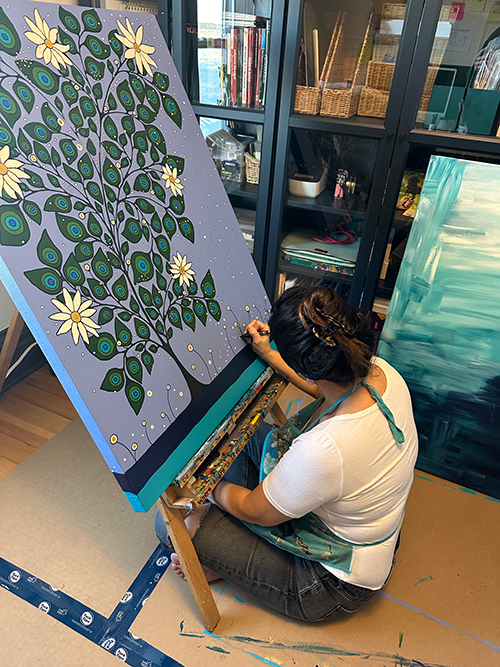
Before I could write it, it first came out in my art. Each dream, each colour, each brush stroke, each vision was a way of holding what could not yet be spoken. It was on the paper and canvas that I stopped controlling and counting what mattered. And just let it be whatever it will be. The colour and brush strokes flowed. With each movement, I could feel the weight of control ease around my shoulder as I poured my deepest and darkest fears and loving thoughts and prayers into the paint. The work moved as I moved. It changed as I changed. It carried what I was becoming.
It wasn’t until several years later that the art became animation. It started as writer’s block. I couldn’t find the words to compliment the paintings and the knowledge and practice I inherently knew. It was through animation that we brought the images to life. And as they moved, as they breathed and unfolded, I saw something I had not been able to see before. I saw movement. And from that movement, I finally found the words. Not to explain the journey, but to walk it.