
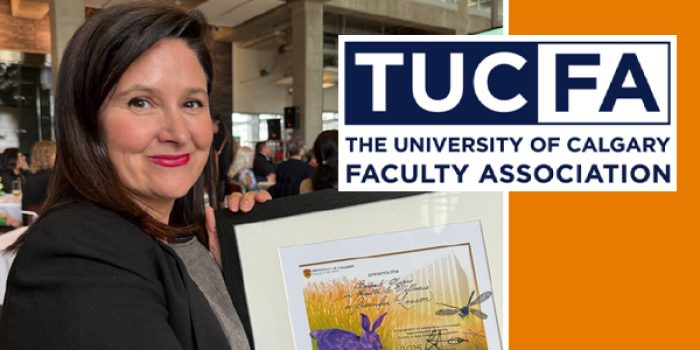
Dr. Jennifer Leason was featured in The University of Calgary Faculty Association (TUCFA) newsletter in March in its Member Profile. After 20 years of front line service and 8 years in the academy, her message remains the same:
Stop building empires. Start paying local people, a local working wage to support other local people. Whether it's birth workers, midwives, nurses, daycare workers, teachers, or any front line service... start investing at home and in community.
Jennifer Leason
Dr. Jennifer Leason – Advocating for Life, Dignity, and the Return of What Was Taken
Her work, focused on Indigenous maternal health, reproductive justice and Indigenous matriarchy, is driven by a simple, powerful question: Why aren’t we doing things that make sense?
Her motivation springs from her own story. On her mother’s side, she has felt the embodied impacts of colonialism, losing her grandmother at 63 and her mother at 59. “It’s really motivated me to live my life most imagined … and to be that change for my own children and for generations to come,” she says.
This drive for reconciliation and justice fuels her two flagship projects. The first, Reclaiming Indigenous Birth, partners with the National Council of Indigenous Midwives (NCIM) to challenge the costly and disruptive practice of evacuating Indigenous pregnant people from their communities. While her team has built an economic and health indicators analysis comparing these costs and outcomes to funding local midwifery, for Dr. Leason, the core argument is about dignity, not dollars.
She illustrates this with a memory from the mid-1990s: a young mother, alone and in clear pain, boarding a bus just after giving birth, clutching a newborn car seat and a garbage bag of belongings. When asked if she wanted water or a sandwich, she said, ‘No, thank you. I don’t want to have to get up to use the bathroom,’” Dr. Leason recalls. “No one in this day and age should ever have to not take a sip of water after giving birth.” Her research, therefore, offers a solution: “Invest in persons that want to become birth workers and midwives … Start paying local women a local living wage to support other local women.”
Her second project, Honouring Voices, examines the reproductive health of incarcerated Indigenous women. She sees a profound connection between the two. Both, she explains, involve asking basic questions of federal institutions responsible for care: How many people and children are affected? What is the cost? What is their health status? In both cases, after years of asking, the answer is often the same: the system doesn’t know.
“I always made the assumption that our institutions and systems… were making evidence-based decisions,” she says. Discovering this “data injustice” revealed a deeper truth. “The link between those two projects is that: why is it up to us as Indigenous matriarchs and researchers … always having to prove it? When is it the system and institutional responsibility to be accountable?”
This challenge to “prove it” is at the heart of how Dr. Leason reconceives research itself. She rejects the traditional, extractive model where the academic is the sole expert. “We are no longer the recipients and research subjects, but rather the authors of our own knowledges and stories,” she states. “We’re no longer placing Indigenous peoples and communities under the microscope … It’s about placing our systems, our structures, colonialism, the impacts of that under the microscope.”
Her message to policymakers is direct and urgent. She has watched investments disappear into bureaucratic empires—directors, managers, and consultants. “Stop building empires,” she urges. “Stop hiring five suits and start investing in 50 midwives.”
“Get the money to where it needs to go,” she insists. “Invest in Indigenous curriculum, invest in student cohorts, invest in a workforce, planning and building from the grassroots, from the ground up.” Her final, resonant plea is not for more help, but for the space to enact solutions that communities already hold: “I’m not asking you to do it for us, but I am asking you to step out of the way.”